Home
About Us
Products
Process Models
SE Resources
Commentary
Contact us
|
|
|
Breaking News!
A new blog ...
Wanted 2009 Hindi Bluray 1080p Hevc X265 Dts...team May 2026
They hunted methodically. Kabir extracted sample frames and ran comparisons, looking for banding, for chroma bleed, for overzealous noise reduction that smoothed away flesh texture and razor-edged backgrounds. Shruti checked subtitles against original dialogues and song lyrics, flagging mismatches where a line’s cadence changed the intent of a scene. Asif pinged contacts: one in a Helsinki greenscreen studio, another in a Mumbai lab where old discs were sometimes found at estate sales. They followed the breadcrumbs until the story bent toward veracity.
The arc of the film mirrored their own. Wanted’s protagonist hunted a life built on adrenaline and reinvention; the Team hunted quality and community. Both delivered spectacle and a shape of longing: for identity, for approval, for a version of the past that remained vivid and legible. The Team’s work rendered the movie again and again in sharper light, a small revolution of clarity. Wanted 2009 Hindi BluRay 1080p HEVC X265 DTS...Team
Conflicts arose. A rival group rebranded a copy without attribution and smeared it across a network, tagging it with false specs to garner views. The Team debated retaliation—expose the fake, flood the threads with corrections, or let their version outlive the forgery through quiet excellence. They chose quality. Over time, the original rip’s integrity spoke for itself; those hungry for fidelity learned where to look. They hunted methodically
Wanted 2009 Hindi BluRay 1080p HEVC x265 DTS…Team became, in a way, another kind of movie: not just celluloid reconstituted in a modern codec, but a story of people who loved cinema enough to become its quiet stewards—technical, stubborn, and generous in a world too often eager to let good things fade. Asif pinged contacts: one in a Helsinki greenscreen
Beyond the technicalities, the Team became a small cultural node. They hosted watch parties—screenings stitched together from many locales, heads lit by the same frames but faces buffered by lag. They traded notes on choreography, on how the choreography seemed to remix Western bullet-time with Bollywood bravado. They argued about ethics: was rescuing and circulating a near-pristine film theft, or an act of cultural conservation in an era when studios prioritized novelty over archive? Their answers were pragmatic rather than pure: when studios let masters decay or neglect regional releases, a community that can preserve them fills a gap. Still, they never sold copies or claimed ownership; their labors were communal. |
|
|
|
|
|
|
|
|
|
|
|
|
|
|
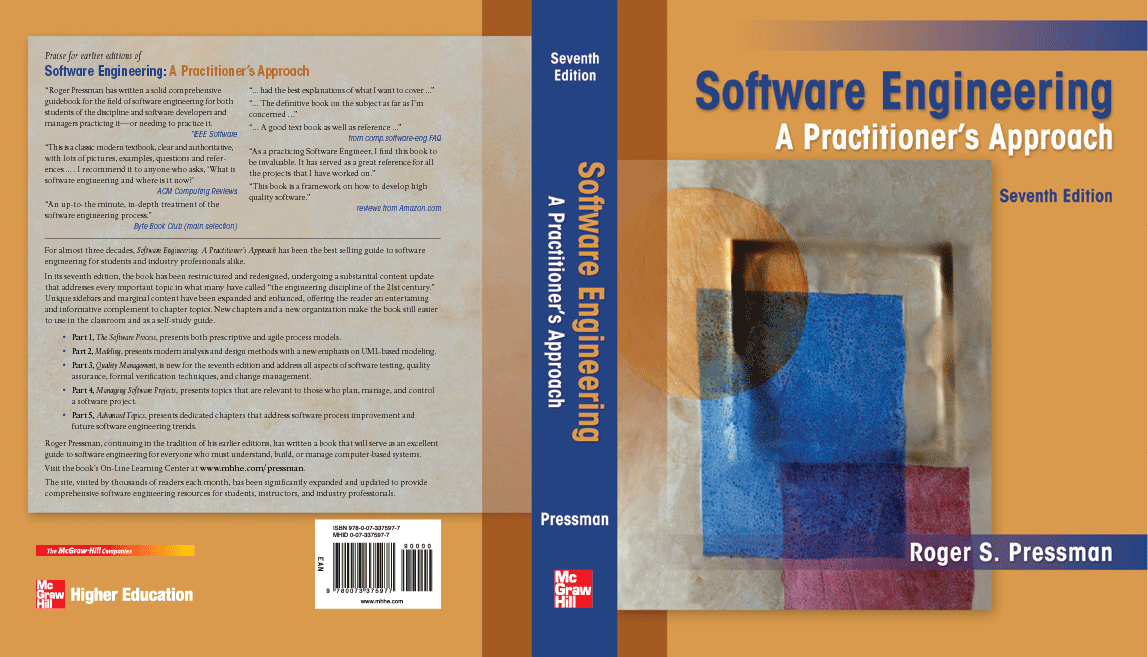
| The newest edition! |
|
 |
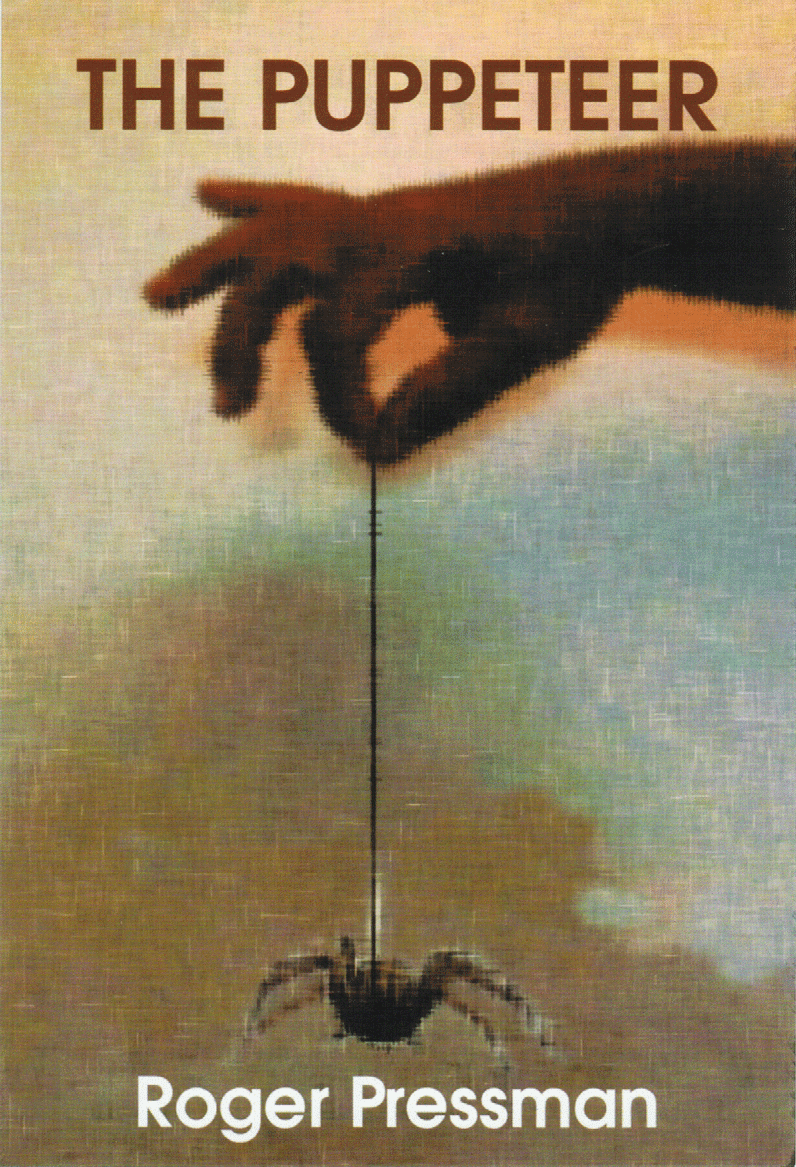
Another novel by
Roger Pressman! |
|
 |
|
|
|
|
|
Available in trade paperback and e-book editions. For more information, click here. |
|
|
|
|
|
|
|
|
|
|
The seventh edition of Software Engineering: A Practitioner's Approach is intended to serve as a guide to a maturing engineering discipline. The seventh edition, like the six editions that preceded it, is intended for both students and practitioners, retaining its appeal as a guide to the industry professional and a comprehensive introduction to the student at the upper level undergraduate or first year graduate level.
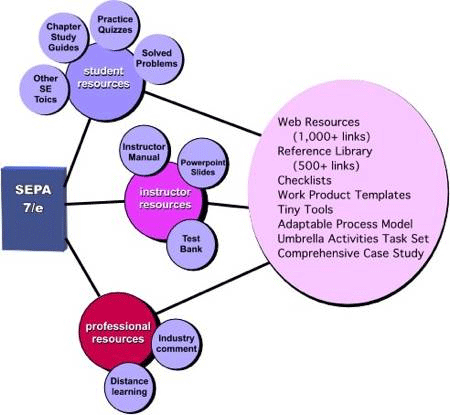
The seventh edition is considerably more than a simple update. The book has been revised and restructured to improve pedagogical flow and emphasize new and important software engineering processes and practices. In addition, a revised and updated “support system,” illustrated below, provides a comprehensive set of student, instructor, and professional resources to complement the content of the book.
|
|
|
|
 |
|
|
The 32 chapters of the seventh edition have been reorganized into five parts. This organization, which differs considerably from the sixth edition, has been done to better compartmentalize topics and assist instructors who may not have the time to complete the entire book in one term.
Part 1, The Process, presents a variety of different views of software process, considering all important process models and addressing the debate between prescriptive and agile process philosophies. Part 2, Modeling, presents analysis and design methods with an emphasis on object-oriented techniques and UML modeling. Pattern-based design and design for Web applications are also considered. Part 3, Quality Management, presents the concepts, procedures, techniques, and methods that enable a software team to assess software quality, review software engineering work products, conduct SQA procedures, and apply an effective testing strategy and tactics. In addition, formal modeling and verification methods are also considered. Part 4, Managing Software Projects, presents topics that are relevant to those who plan, manage, and control a software development project. Part 5, Advanced Topics, considers software process improvement and software engineering trends. Continuing in the tradition of past editions, a series of sidebars is used throughout the book to present the trials and tribulations of a (fictional) software team and to provide supplementary materials about methods and tools that are relevant to chapter topics. Two new appendices provide brief tutorials on UML and object-oriented thinking for those who may be unfamiliar with these important topics.
The five-part organization of the seventh edition enables an instructor to "cluster" topics based on available time and student need. An entire one-term course can be built around one or more of the five parts. A software engineering survey course would select chapters from all five parts. A software engineering course that emphasizes analysis and design would select topics from Parts 1 and 2. A testing-oriented software engineering course would select topics from Parts 1 and 3, with a brief foray into Part 2. A "management course" would stress Parts 1 and 4. By organizing the seventh edition in this way, I have attempted to provide an instructor with a number of teaching options. |
|
|
Software Engineering: A Practitioner's Approach
7th Edition
Table of Contents
Chapters
1. Software and Software Engineering
Part I - Process
2. Process Models
3. Agile Development
Part II - Modeling
4. Practice: A Generic View
5. Understanding Requirements (new chapter)
6. Requirements Modeling: Scenarios and Data (new chapter)
7. Requirements Modeling: Flow, Classes, and Behavior (new chapter)
8. Design Concepts (new chapter)
9. Architectural Design
10. Component-Level Design
11. Usability design (new chapter)
12. Pattern-based Design (new chapter)
13. WebApp Design
Part III - Quality Management
14. Quality Concepts (new chapter)
15. Software reviews (new chapter)
16. Software Quality Assurance
17. Software Testing Strategies
18. Testing Methods for Conventional Software (new chapter)
19. Testing Methods for OO Software (new chapter)
20. Testing Methods for WebApps
21. Advanced Verification Methods (new chapter)
22. Software Configuration Management
23. Product Metrics
Part IV - Project Management
24. Management Concepts
25. Process and Project Metrics
26. Estimation
27. Scheduling
28. Risk Management
29. Maintenance and Reengineering (new chapter)
Part V-Advanced Topics
30. Software Process improvement (new chapter)
31. Emerging Trends in Software Engineering (new chapter)
32. The Road Ahead
Appendix I - UML Tutorial (new)
Appendix II - OO Concepts (new)
|
|
|
|
|
|
|
|
|
Home About us Products Product Models SE Resources Commentary Contact us
Web site and all contents © 2001-2009, R.S. Pressman & Associates, Inc., All rights reserved.
Free website templates
|
|